You notice a brown ring on the ceiling, or the paint bubbling over a sliding door, and the deck is right above it. The instinct is to scrape, patch and repaint. Hold off. The stain only tells you where the water ended up. The real job is finding where it started, and that's usually somewhere else entirely.
Where the water usually gets in.
Water travels. It can enter at one spot, run along a joist or the top of a wall, and drip out a few feet away. These are the usual starting points.
Where the deck meets the house.
Most attached decks hang off a board bolted to the house, called the ledger. Flashing is supposed to sit over it and shed water out past the siding. When that flashing is missing, rusted, or was never tucked under the siding, rain runs straight behind the ledger and into the wall and rim joist of the house. Caulk is not flashing; a bead of it buys a little time at most.
Door thresholds.
A slider or French door onto the deck needs a pan under its sill that catches any water and sends it back outside. Without one, water that gets past the door drains into the floor framing below. Snow piled against the door makes this worse, because meltwater sits right at the threshold.
Decking over living space.
If the deck sits on top of a room, like over a porch, a garage or an addition, there's a waterproof membrane under the boards doing all the work. Any hole in it leaks: a railing post fastened through it, a seam that let go, a drain that clogged, or a spot where it stops short at the wall.
Gutters and downspouts.
A gutter that overflows onto the deck, or a downspout that empties right where the deck meets the house, puts far more water at the weak spots than rain alone. Sometimes the fix starts on the roof.
The signs inside.
- A ceiling stain that grows after rain or a thaw.
- Paint bubbling or peeling near the ceiling or around a door.
- Drywall that sags or feels soft when you press it.
- Door trim or a floor near the slider that's dark, swollen or spongy.
- Rust spots showing through the ceiling where nails or screws are.
- A musty smell when the room's been closed up.
- From outside: soft wood at the ledger, or rot at the bottom of the door frame.
Note when it happens. A leak that only shows after wind-driven rain from one direction points to a different spot than one that shows during every spring thaw. That history helps whoever is tracking it down. So does knowing what's above the stain: a door, a post, a downspout, or open deck boards. Sketch it on paper if you have to. It's a lot easier to trace a leak when you know which inside spot lines up with which outside spot.
Why patching the ceiling first is backwards.
A new patch and fresh paint look great until the next storm. Meanwhile the water keeps soaking the framing you can't see, and now the evidence that showed where it was going is painted over. Wet insulation and drywall left in place are also the perfect home for mold.

The order to fix it.
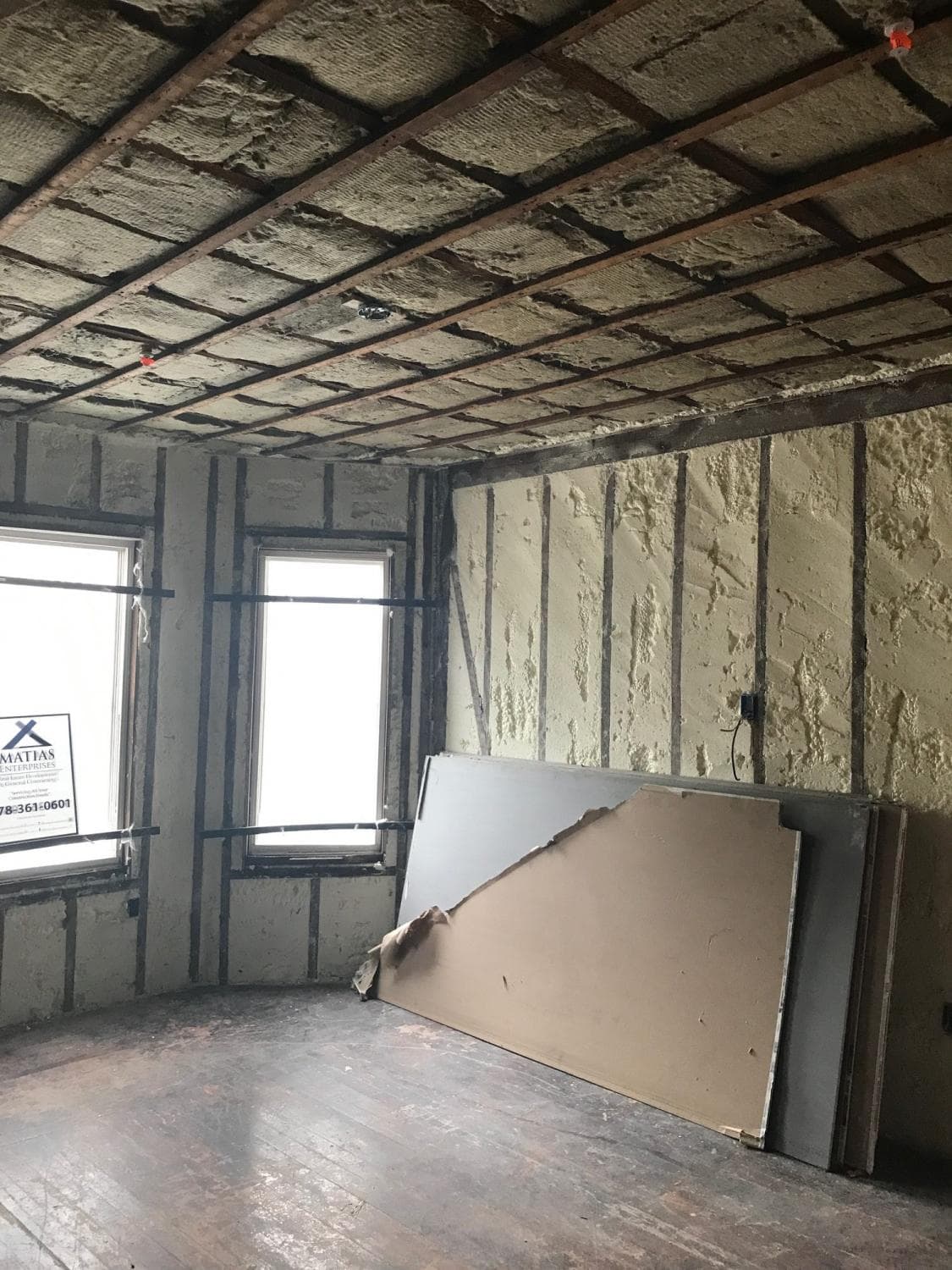
- Find the source. Look over the flashing, threshold, membrane and gutters, then run a hose on one area at a time while someone watches inside. Open the ceiling where needed to see where the water shows up.
- Dry it out and check the framing. Pull wet insulation and drywall. Probe the ledger, rim joist, joists and door sill for rot.
- Repair the framing. Replace rotted wood before anything gets closed back up.
- Fix the water path. Proper flashing at the ledger, a pan under the door, membrane repairs, and gutters and downspouts that send water away.
- Rebuild the deck parts that came off. Decking, railings or stairs go back on, repaired or replaced.
- Then the room below. Insulation, drywall, a stain-blocking primer over any old marks, and paint.
That's the order that worked for Lam M., who called DT about a leak under the deck: "DT was able to find the source of the leak and fixed our problem." Finding the source is the whole job. The patch is the easy part.
What you can check this weekend.
- Clean the gutters above the deck and watch where the downspouts empty.
- Look under the deck at the ledger for dark, soft or stained wood.
- Check whether you can see metal flashing above the ledger, tucked under the siding.
- Keep snow shoveled away from the door threshold in winter.
- Take photos of the ceiling stain after each storm so you can see if it grows.
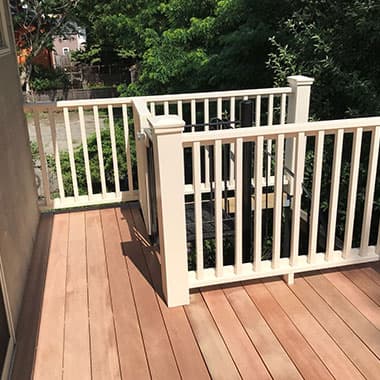
If the deck itself is near the end of its life, it may make sense to rebuild rather than repair. Our guide to choosing deck boards covers the options. You can also read more on our decks page, or see the notes for deck repair in Revere, where salt air adds its own wear.
Common questions
Yes. A deck attached to the side of the house can let water in at the ledger, and it runs into the wall and rim joist, showing up in a basement or a room beside the deck.
Not as a real fix. Caulk cracks and pulls away; the ledger needs proper flashing that sheds water out past the siding.
The deck. Find and fix the source, dry out and repair the framing, then repair the ceiling last so it only has to be done once.